
Primary Antibody Matched Pairs


Abcam Rat brain tissue lysate - mitochondrial extract, 2 mg
Antibody, suitable for WB, SDS-PAGE, IP.


Invitrogen™ MALT1 Recombinant Rabbit Monoclonal Antibody (24GB440)

Rabbit Recombinant Monoclonal Antibody

Invitrogen™ TRAP1 Recombinant Rabbit Monoclonal Antibody (24GB2560)
Rabbit Recombinant Monoclonal Antibody


Sino Biological Rat Tissue Factor Matched ELISA Antibody Pair Set 15 Plates
The Rat Coagulation Factor III / Tissue Factor / CD142 ELISA Pair Set is for the quantitative determination of Rat Coagulation Factor III / Tissue Factor / CD142.The Sino Biological ELISA Pair Set is a solid phase sandwich ELISA (Enzyme-Linked Immunosorbent Assay). It utilizes a monoclonal antibody specific for Rat Coagulation Factor III / Tissue Factor / CD142 coated on a 96-well plate. Standards and samples are added to the wells, and any Rat Coagulation Factor III / Tissue Factor / CD142 present binds to the immobilized antibody. The wells are washed and a horseradish peroxidase conjugated rabbit anti-Rat Coagulation Factor III / Tissue Factor / CD142 polyclonal antibody is then added, producing an antibody-antigen-antibody "sandwich". The wells are again washed and TMB substrate solution is loaded, which produces color in proportion to the amount of Rat Coagulation Factor III / Tissue Factor / CD142 present in the sample. To end the enzyme reaction, the stop solution is added an

Sino Biological Rat Tissue Factor Matched ELISA Antibody Pair Set 5 Plates
The Rat Coagulation Factor III / Tissue Factor / CD142 ELISA Pair Set is for the quantitative determination of Rat Coagulation Factor III / Tissue Factor / CD142.The Sino Biological ELISA Pair Set is a solid phase sandwich ELISA (Enzyme-Linked Immunosorbent Assay). It utilizes a monoclonal antibody specific for Rat Coagulation Factor III / Tissue Factor / CD142 coated on a 96-well plate. Standards and samples are added to the wells, and any Rat Coagulation Factor III / Tissue Factor / CD142 present binds to the immobilized antibody. The wells are washed and a horseradish peroxidase conjugated rabbit anti-Rat Coagulation Factor III / Tissue Factor / CD142 polyclonal antibody is then added, producing an antibody-antigen-antibody "sandwich". The wells are again washed and TMB substrate solution is loaded, which produces color in proportion to the amount of Rat Coagulation Factor III / Tissue Factor / CD142 present in the sample. To end the enzyme reaction, the stop solution is added an


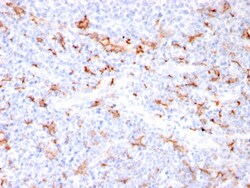
Biotium S100A9 + Calprotectin (S100A8/A9 Complex)(MAC3157R), CF647 conjugate, 0.1mg/mL
Recognizes the L1 or Calprotectin molecule, an intra-cytoplasmic antigen comprising of a 12 kDa alpha chain and a 14 kDa beta chain expressed by granulocytes, monocytes and by tissue macrophages. Macrophages usually arise from hematopoietic stem cells in the bone marrow. Under migration into tissues, the monocytes undergo further differentiation to become multifunctional tissue macrophages. They are classified into normal and inflammatory macrophages. Normal macrophages include macrophages in connective tissue (histiocytes), liver (Kupffer's cells), lung (alveolar macrophages), lymph nodes (free and fixed macrophages), spleen (free and fixed macrophages), bone marrow (fixed macrophages), serous fluids (pleural and peritoneal macrophages), skin (histiocytes, Langerhans's cell) and in other tissues. Inflammatory macrophages are present in various exudates. Macrophages are part of the innate immune system, recognizing, engulfing and destroying many potential pathogens including
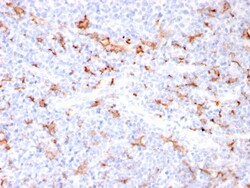
Biotium S100A9 + Calprotectin (S100A8/A9 Complex)(MAC3157R), CF488A conjugate, 0.1mg/mL
Recognizes the L1 or Calprotectin molecule, an intra-cytoplasmic antigen comprising of a 12 kDa alpha chain and a 14 kDa beta chain expressed by granulocytes, monocytes and by tissue macrophages. Macrophages usually arise from hematopoietic stem cells in the bone marrow. Under migration into tissues, the monocytes undergo further differentiation to become multifunctional tissue macrophages. They are classified into normal and inflammatory macrophages. Normal macrophages include macrophages in connective tissue (histiocytes), liver (Kupffer's cells), lung (alveolar macrophages), lymph nodes (free and fixed macrophages), spleen (free and fixed macrophages), bone marrow (fixed macrophages), serous fluids (pleural and peritoneal macrophages), skin (histiocytes, Langerhans's cell) and in other tissues. Inflammatory macrophages are present in various exudates. Macrophages are part of the innate immune system, recognizing, engulfing and destroying many potential pathogens including
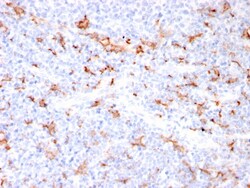
Biotium S100A9 + Calprotectin (S100A8/A9 Complex)(MAC3157R), CF405S conjugate, 0.1mg/mL
Recognizes the L1 or Calprotectin molecule, an intra-cytoplasmic antigen comprising of a 12 kDa alpha chain and a 14 kDa beta chain expressed by granulocytes, monocytes and by tissue macrophages. Macrophages usually arise from hematopoietic stem cells in the bone marrow. Under migration into tissues, the monocytes undergo further differentiation to become multifunctional tissue macrophages. They are classified into normal and inflammatory macrophages. Normal macrophages include macrophages in connective tissue (histiocytes), liver (Kupffer's cells), lung (alveolar macrophages), lymph nodes (free and fixed macrophages), spleen (free and fixed macrophages), bone marrow (fixed macrophages), serous fluids (pleural and peritoneal macrophages), skin (histiocytes, Langerhans's cell) and in other tissues. Inflammatory macrophages are present in various exudates. Macrophages are part of the innate immune system, recognizing, engulfing and destroying many potential pathogens including
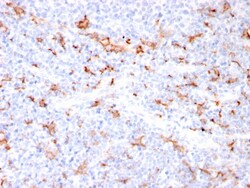
Biotium S100A9 + Calprotectin (S100A8/A9 Complex)(MAC3157R), Biotin conjugate, 0.1mg/mL
Recognizes the L1 or Calprotectin molecule, an intra-cytoplasmic antigen comprising of a 12 kDa alpha chain and a 14 kDa beta chain expressed by granulocytes, monocytes and by tissue macrophages. Macrophages usually arise from hematopoietic stem cells in the bone marrow. Under migration into tissues, the monocytes undergo further differentiation to become multifunctional tissue macrophages. They are classified into normal and inflammatory macrophages. Normal macrophages include macrophages in connective tissue (histiocytes), liver (Kupffer's cells), lung (alveolar macrophages), lymph nodes (free and fixed macrophages), spleen (free and fixed macrophages), bone marrow (fixed macrophages), serous fluids (pleural and peritoneal macrophages), skin (histiocytes, Langerhans's cell) and in other tissues. Inflammatory macrophages are present in various exudates. Macrophages are part of the innate immune system, recognizing, engulfing and destroying many potential pathogens including
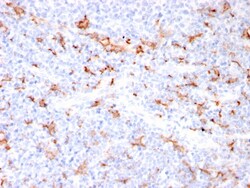
Biotium S100A9 + Calprotectin (S100A8/A9 Complex)(MAC3157R), Biotin conjugate, 0.1mg/mL
Recognizes the L1 or Calprotectin molecule, an intra-cytoplasmic antigen comprising of a 12 kDa alpha chain and a 14 kDa beta chain expressed by granulocytes, monocytes and by tissue macrophages. Macrophages usually arise from hematopoietic stem cells in the bone marrow. Under migration into tissues, the monocytes undergo further differentiation to become multifunctional tissue macrophages. They are classified into normal and inflammatory macrophages. Normal macrophages include macrophages in connective tissue (histiocytes), liver (Kupffer's cells), lung (alveolar macrophages), lymph nodes (free and fixed macrophages), spleen (free and fixed macrophages), bone marrow (fixed macrophages), serous fluids (pleural and peritoneal macrophages), skin (histiocytes, Langerhans's cell) and in other tissues. Inflammatory macrophages are present in various exudates. Macrophages are part of the innate immune system, recognizing, engulfing and destroying many potential pathogens including
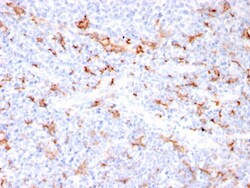
Biotium S100A9 + Calprotectin (S100A8/A9 Complex)(MAC3157R), CF405S conjugate, 0.1mg/mL
Recognizes the L1 or Calprotectin molecule, an intra-cytoplasmic antigen comprising of a 12 kDa alpha chain and a 14 kDa beta chain expressed by granulocytes, monocytes and by tissue macrophages. Macrophages usually arise from hematopoietic stem cells in the bone marrow. Under migration into tissues, the monocytes undergo further differentiation to become multifunctional tissue macrophages. They are classified into normal and inflammatory macrophages. Normal macrophages include macrophages in connective tissue (histiocytes), liver (Kupffer's cells), lung (alveolar macrophages), lymph nodes (free and fixed macrophages), spleen (free and fixed macrophages), bone marrow (fixed macrophages), serous fluids (pleural and peritoneal macrophages), skin (histiocytes, Langerhans's cell) and in other tissues. Inflammatory macrophages are present in various exudates. Macrophages are part of the innate immune system, recognizing, engulfing and destroying many potential pathogens including
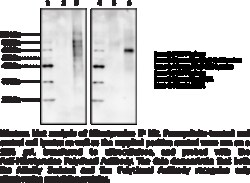
Cayman Chemical Nitrotyrosine IP Kit, 1 ea
For the capture and pulldown of nitrated proteins from cell and tissue lysates